The River Within | Part Three
The Still Point
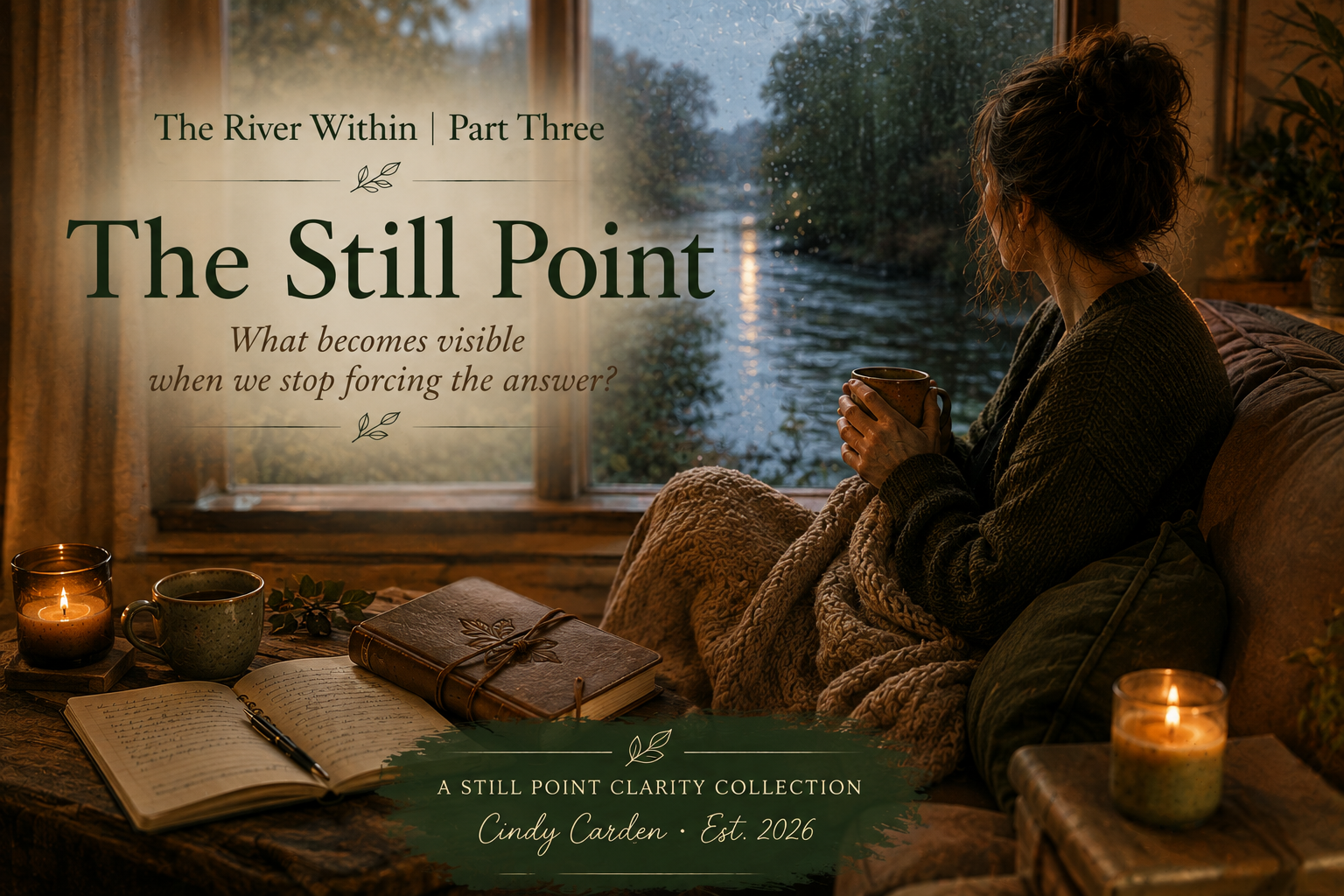
What becomes visible when we stop forcing the answer?
The power went out at 8:43 on a Thursday night.
She knew the exact time because she'd been looking at the microwave when it happened.
One second it read 8:43.
The next, nothing.
The television went silent.
The refrigerator stopped humming.
The lamp beside her disappeared.
And the house became completely still.
She sat there for a moment.
Then did what any reasonable person in 2026 would do.
She picked up her phone.
No Wi-Fi.
Of course.
She checked the weather.
Then her messages.
Then the power company's website.
Estimated restoration time: 11:30 p.m.
“Perfect.”
She said it to no one.
She found the flashlight in the kitchen drawer underneath three batteries that didn't fit anything she owned, two takeout menus, and approximately forty-seven pens.
Then she lit a candle.
There wasn't much else to do.
She couldn't finish the laundry.
Couldn't watch the show she'd been half-watching.
Couldn't answer the emails she'd told herself she'd get to tonight.
She could use her phone, but the battery was already at 22 percent.
So she sat down.
At first, the quiet was annoying.
Then uncomfortable.
Then strangely noticeable.
She could hear rain tapping against the windows.
A car moving slowly along the wet street.
The little tick of the clock in the hallway—the one she'd apparently owned for years without ever actually hearing.
She pulled the blanket over her legs.
And sat.
For once, nothing was asking her to decide anything.
The Space Between
For the past several weeks, she'd been trying to answer questions.
Big ones.
Small ones.
Questions about what she wanted.
Questions about what she was carrying.
Questions about what needed to change.
She'd become surprisingly good at asking herself questions.
Answers were another matter.
Some days she felt as though she was getting somewhere.
Other days she felt exactly where she'd started.
And underneath all of it was a quiet urgency:
I need to figure this out.
She hadn't realized how exhausting that sentence had become.
Until the lights went out.
Sitting there in the candlelight, she wasn't figuring anything out.
She wasn't journaling.
She wasn't listening to a podcast about becoming the next version of herself.
She wasn't making a plan.
She wasn't even trying to be mindful.
She was just sitting on her couch because there wasn't much else to do.
And somewhere in the middle of doing absolutely nothing productive, a thought appeared.
Not an answer.
Just a thought.
I miss walking.
She almost laughed.
Walking?
With everything she'd been trying to understand about her life, that was what her mind came up with?
But she stayed with it.
She used to walk all the time.
Not for exercise.
Not to hit ten thousand steps.
Not while listening to something educational.
She used to walk because she liked being outside.
Sometimes she'd take the long way home simply because the evening was beautiful.
She couldn't remember the last time she'd done that.
There was nothing revolutionary about this realization.
It wasn't going to change her life overnight.
It didn't answer the bigger questions.
But it felt...
true.
And she hadn't had to work very hard to find it.
When the Water Becomes Quiet
There are places along a river where the current slows.
The water that rushed around rocks and carried branches downstream begins to settle.
And when it does, something changes.
You can see differently.
Reflections appear on the surface.
Details become visible that moving water had distorted.
The river hasn't stopped being a river.
It's simply moving differently.
We have places like that within us too.
I think of them as still points.
Not permanent destinations.
Not perfect states of peace.
Not places where we've finally mastered our lives and nothing bothers us anymore.
A still point can be much smaller than that.
A quiet drive without the radio.
The few minutes before everyone else wakes up.
Sitting outside with coffee.
Walking without tracking the walk.
Standing at the kitchen window while the rain falls.
Sometimes even a power outage we absolutely did not request.
These moments don't necessarily give us answers.
But they can create enough space for us to notice what constant movement has made difficult to hear.
Stillness Isn't the Same as Stopping
Stillness can be uncomfortable.
Especially when we've learned to measure our days by what we've accomplished.
If we're not doing something, we may feel as though we're wasting time.
If we're uncertain, we may assume we should be searching harder.
If we're between chapters, we may feel pressure to hurry into the next one.
So we fill the space.
We scroll.
Research.
Plan.
Ask everyone what they think.
Make another list.
Listen to another podcast.
Read another article.
Sometimes those things help.
And sometimes we're consuming so many answers that we can no longer hear our own questions.
The Still Point isn't asking us to stop living.
It's asking something much gentler:What happens if I stop forcing the answer for a little while?
Back in the Candlelight
Her phone buzzed.
Power restoration update: 9:47 p.m.
Much sooner than expected.
She should have been happy.
Instead, she felt strangely disappointed.
That surprised her.
She looked around the room.
The candle flickered against the wall.
Rain continued tapping against the windows.
For nearly an hour, she'd had nowhere else she needed to be.
Nothing she'd needed to accomplish.
And somehow that tiny interruption had given her something she hadn't known she'd been missing.
Space.
At 9:51, the refrigerator came back to life.
The microwave flashed.
12:00.
The television made its little startup sound.
The house resumed.
She reached for the remote.
Then stopped.
She turned the television back off.
And sat there a little longer.
Pause at the River
You don't need a power outage to find a still point.
And you certainly don't need to become someone who meditates on a mountaintop at sunrise.
You only need enough space to notice.
Consider:
Where does quiet naturally exist in my life already?
When do I feel least pressured to perform, decide, or accomplish something?
What do I immediately reach for when things become quiet?
When was the last time something simple made me feel genuinely like myself?
What have I been trying so hard to figure out that I haven't given myself room to notice?
Don't chase the answer.
See what comes.
The Small Things Count
We often expect clarity to arrive dramatically.
A breakthrough.
A decision.
A sudden realization that changes everything.
Sometimes it does.
But often clarity arrives much more quietly.
I miss walking.
I don't want to keep doing this every weekend.
I feel better when I spend time with her.
I haven't laughed much lately.
I actually like this part of my work.
I'm tired of pretending that doesn't bother me.
I want more time outside.
I miss making things.
I don't think I want what I used to want.
None of these statements tells us exactly what to do next.
But they tell us something about what is true now.
And truth noticed without immediately demanding action can become the beginning of clarity.
Something to Carry With You
Sometime this week, find ten minutes that don't need to accomplish anything.
No journal required.
No worksheet.
No podcast.
No personal-development assignment hiding behind the exercise.
Sit outside.
Drink your coffee before it gets cold.
Take the dog around the block.
Stand beside a window.
Leave the radio off in the car.
And notice.
Not:
What should I do?
Not:
What's my next step?
Not even:
What am I supposed to learn from this?
Just: What do I notice when nothing is demanding an answer from me?
That's enough.
The River Continues
The next evening, she went for a walk.
She didn't track it.
She didn't bring headphones.
She didn't decide how far she was going.
She just walked.
The air smelled different after the rain.
At one point she reached the corner where she usually turned toward home.
She stood there for a moment.
Then kept going.
Not because she'd figured anything out.
Not because she'd suddenly discovered the direction of her life.
She simply wanted to see what was around the next corner.
And maybe movement could begin like that.
Not with certainty.
Not with pressure.
But with something small becoming possible.
Next in The River Within
04 | Returning to Flow
Movement doesn't always begin with a bigger push.
→ Continue to Returning to Flow
← Return to The River Within Collection
Before You Go
We don't need to live at the still point.
Rivers don't.
Neither do we.
We return to responsibilities, relationships, decisions, work, laundry, emails, appointments, and all the ordinary movement of being human.
But perhaps we can learn to recognize the places where the water quiets.
And return to them occasionally.
Not because the stillness will hand us a map.
But because sometimes, when everything else becomes quiet enough,
we can finally hear what has been there all along.
The River Within is an original Still Point Clarity collection created by Cindy Carden.
© 2026 Cindy Carden. All rights reserved.
Your second block of text...
Welcome
🌿SOMETHING FEELS OFF?

🌊 COLLECTIONS

The River Within
A five-part collection for the seasons when life changes course.