The River Within | Part Four
Returning to Flow
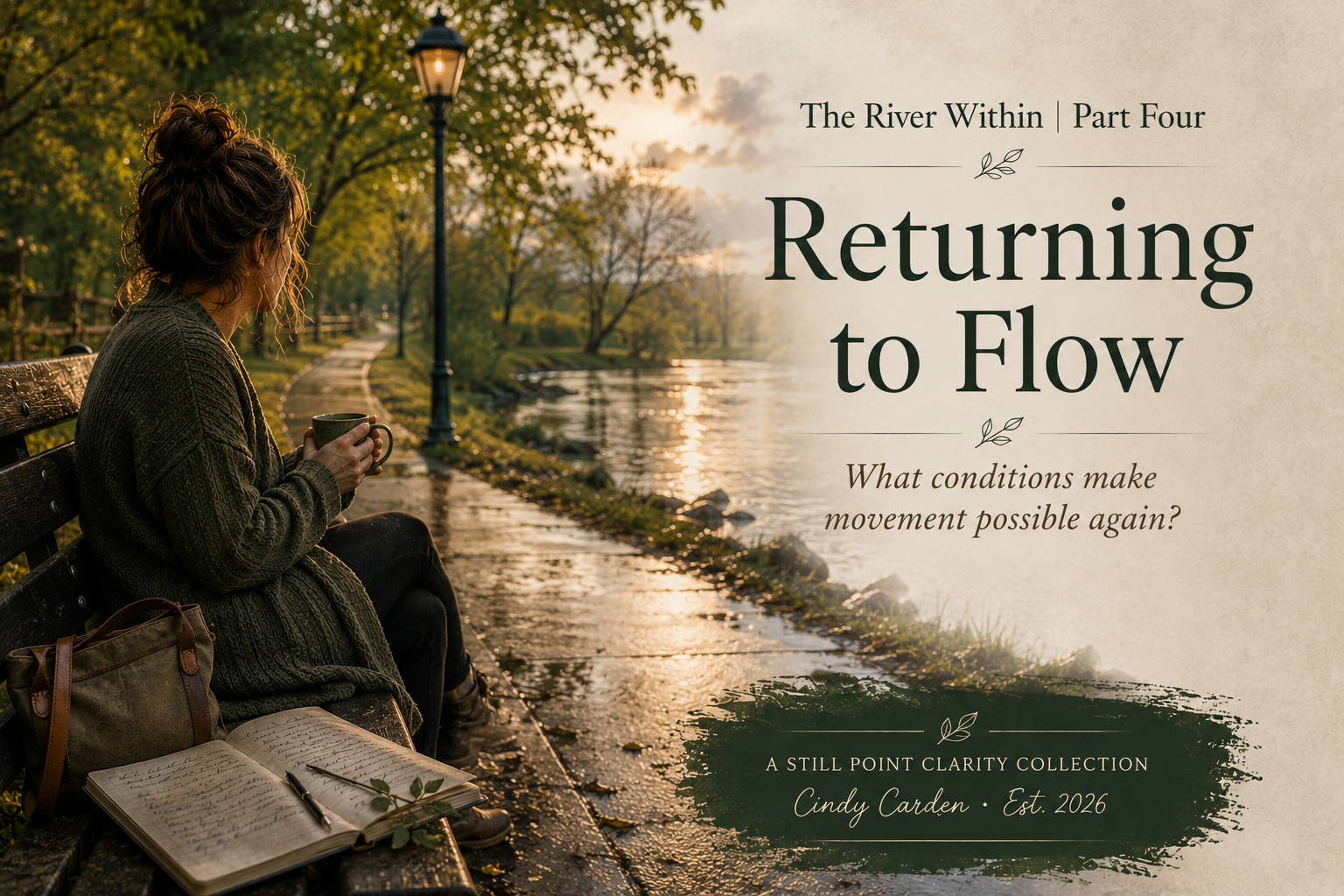
What conditions make movement possible again?
Three days after the power went out, she walked past the corner again.
The same corner where she'd normally turned toward home.
The same corner where, a few nights earlier, she'd surprised herself by continuing straight.
This time she didn't hesitate.
She kept walking.
There was a small park about half a mile farther down the road.
She'd driven past it hundreds of times.
She'd even said, more than once:
“I should walk there sometime.”
Apparently sometime had finally arrived.
She followed the path until it reached a wooden bench overlooking the water.
Then she sat.
No revelation.
No sudden understanding of what she was supposed to do with the rest of her life.
Just a river moving steadily in front of her.
She smiled.
After weeks of trying to figure out how to move forward, apparently her great progress was that she'd walked half a mile farther than usual.
And yet...
something felt different.
Not solved.
Possible.
The Email
The next morning, an email arrived from a woman she'd worked with several years ago.
They hadn't spoken in months.
The subject line said:
Thought of you.
Inside was a link to a small weekend workshop happening nearby.
This sounded like you, her friend had written.
No idea if you're interested, but I thought I'd send it.
She clicked the link.
Then immediately closed it.
Too expensive.
Well, not exactly.
Too indulgent.
She had things she should be doing.
There was work.
The house.
People who needed her.
And besides, what would she even say if someone asked why she was going?
I'm spending Saturday at a workshop because I don't know what I'm doing with my life?
That sounded dramatic.
She deleted the email.
Then retrieved it from the trash five minutes later.
Apparently, clarity was still a work in progress.
Sometimes Movement Needs Something First
When a river stops moving freely, we don't expect the water to solve the problem through determination.
We look at the conditions.
Is something blocking the channel?
Has debris accumulated?
Has the water level changed?
Is there another route available?
What needs to shift for movement to become possible?
Yet when we have difficulty moving, we often ask a very different question:
Why can't I just make myself do it?
We assume motivation should come first.
Then courage.
Then action.
And if those things aren't available, we may decide we're procrastinating, avoiding, failing, or simply not trying hard enough.
But human movement is affected by conditions too.
Do I have enough energy for this?
Do I feel safe enough to try?
Can I see an option that feels possible?
Do I have support?
Does this choice fit who I am now?
Is there enough room in my life for something new?
Am I being asked to make one manageable move—or twenty at once?
Sometimes movement isn't waiting for more discipline.
Sometimes movement is waiting for the conditions that make it available.
Saturday Morning
She registered for the workshop on Thursday night.
Then spent most of Friday thinking about canceling.
By Saturday morning, she'd developed approximately eleven excellent reasons not to go.
It was raining.
She hadn't slept particularly well.
There were things she could get done around the house.
She wouldn't know anyone.
And honestly, staying home with coffee sounded wonderful.
At 8:12, she texted the friend who had sent the email.
I signed up for that thing you sent me. Currently considering pretending I didn't. 😂
Her phone buzzed almost immediately.
Want me to go with you?
She stared at the message.
She hadn't even considered that.
You would?
Yep. Pick you up at 9.
That was it.
Not:
You need to do this.
Not:
Stop making excuses.
Not:
Get outside your comfort zone.
Just:
Want me to go with you?
Something inside her settled.
She typed:
Okay.
What Changed?
Nothing about the workshop changed.
She was still uncertain.
It was still raining.
She still didn't know anyone there.
She still wasn't entirely sure why she wanted to go.
The only thing that changed was:
She didn't have to walk into the room alone.
And suddenly, what had felt difficult became possible.
This is easy to overlook.
We tend to celebrate the visible action.
She went.
But sometimes the more interesting question is:What made going possible?
Support changed the conditions.
And once the conditions changed, movement followed.
Readiness Doesn't Always Look Like Confidence
We sometimes imagine being ready as a feeling.
I'll know.
I'll feel confident.
I'll stop being afraid.
I'll finally be motivated.
But readiness can look much less impressive.
It can sound like:
Okay. I'll try.
Come with me.
Can you help me?
Maybe.
Not today, but perhaps next week.
I could do ten minutes.
I don't know where this leads, but I'm curious.
Readiness isn't always certainty.
Sometimes it's simply enough capacity, enough support, and enough possibility for one next movement to become available.
The Room
The workshop was held in an old brick building she'd passed before but never noticed.
Her friend parked.
They sat in the car for a minute while rain tapped against the windshield.
“You ready?”
She laughed.
“No.”
Her friend shrugged.
“Me neither.”
And somehow that helped too.
Inside, someone handed them name tags.
There was coffee.
There were folding chairs arranged in a circle.
Nothing magical.
Nothing life-changing.
At least not immediately.
But halfway through the morning, the facilitator asked everyone a question:
“What are you curious about right now?”
Not:
What is your goal?
Not:
Where do you see yourself in five years?
Not:
What do you need to fix?
Curious.
She looked down at her notebook.
For once, the page didn't feel demanding.
She wrote:
What would my life feel like if I didn't have to know where everything was going before I let myself begin?
She read it again.
Then underlined one word.
Begin.
The Conditions for Movement
There is rarely one single condition that creates flow.
Different seasons require different things.
Sometimes we need rest before we need action.
Sometimes we need information.
Sometimes we need fewer options rather than more.
Sometimes we need someone beside us.
Sometimes we need permission to change our minds.
Sometimes we need an environment that supports the person we're becoming rather than constantly pulling us toward who we've been.
Sometimes we need a choice small enough that our whole system doesn't respond:
Absolutely not.
And sometimes we simply need to recognize that we're more ready than we were yesterday.
The question becomes less:
How do I force myself forward?
and more:What would make the next movement more available to me?
Pause at the River
Think about something you've been trying to move toward.
Don't begin by asking yourself why you haven't done it.
Instead, become curious about the conditions around it.
Do I have the energy this requires right now?
Do I actually know what my next step is?
Would support make this easier?
Am I trying to move toward something I genuinely want—or something I believe I should want?
Is the step I'm asking myself to take simply too large?
What would make this feel 10% more possible?
Not effortless.
Not certain.
Not fearless.
Just more possible.
A Small Experiment
Choose one place where you've been asking yourself to push harder.
Instead of adding more pressure, change one condition.
If you're overwhelmed by the size of something, make it smaller.
If you're uncertain, gather one piece of information.
If you're exhausted, rest before deciding.
If you're isolated, ask someone to sit beside you.
If you have too many choices, remove a few.
If something doesn't feel like you anymore, give yourself permission to question it.
Then notice what happens.
You aren't trying to manufacture momentum.
You're discovering what supports your movement.
Back at the River
A week later, she returned to the park.
Same bench.
Same water.
Different day.
She thought about the workshop.
It hadn't answered her big questions.
She still didn't know exactly where she was going.
But she had written down the name of a book someone mentioned.
She'd exchanged numbers with another woman.
She'd agreed to meet her friend for coffee the following week.
Tiny things.
Almost embarrassingly tiny compared with the enormous clarity she'd been demanding from herself a few weeks earlier.
But sitting beside the river, she realized something.
She was moving.
Not quickly.
Not dramatically.
But genuinely.
She hadn't needed to force the current.
She had needed enough room for it to return.
Flow Isn't a Finish Line
There will be days when movement feels easy.
And days when it doesn't.
There will be seasons when the river moves quickly and others when it slows again.
Returning to flow doesn't mean we have finally solved ourselves.
It doesn't mean we'll never feel blocked again.
The difference may be that we begin recognizing our own conditions sooner.
I'm depleted.
I need support.
This doesn't feel like mine anymore.
I'm asking too much of myself at once.
I need more information.
I'm not ready yet.
Actually... I think I might be ready now.
Instead of treating every interruption in movement as failure, we begin listening to it.
And that changes our relationship with the river.
The River Continues
There was one question still waiting.
She could feel it.
All this noticing had changed something.
She understood more about what had blocked her.
She'd begun seeing what she'd been carrying.
She'd discovered the value of stillness.
And now movement was returning.
But movement eventually asks us something.
Which direction?
She looked downstream.
The river curved beyond the trees and disappeared from view.
She couldn't see where it went.
For once, that didn't bother her quite as much.
Maybe she didn't need to see the whole river.
Maybe she only needed to choose whether she was willing to follow it to the next bend.
Next in The River Within
05 | Choosing the Next Bend
You don't have to see the whole river to move toward what comes next.
→ Continue to Choosing the Next Bend
← Return to The River Within Collection
Before You Go
You don't need perfect conditions before you're allowed to move.
Life rarely gives us those.
But you can begin noticing the difference between forcing yourself forward and creating conditions that make forward movement more available.
Sometimes courage helps.
Sometimes a plan helps.
Sometimes rest helps.
Sometimes information helps.
And sometimes the thing that changes everything is simply someone saying:
“Want me to go with you?”
The river doesn't move because it tries harder to be a river.
It moves when the conditions allow the water to find its way.
Perhaps we can offer ourselves some of that same grace.
The River Within is an original Still Point Clarity collection created by Cindy Carden.
© 2026 Cindy Carden. All rights reserved.
Welcome
🌿SOMETHING FEELS OFF?

🌊 COLLECTIONS
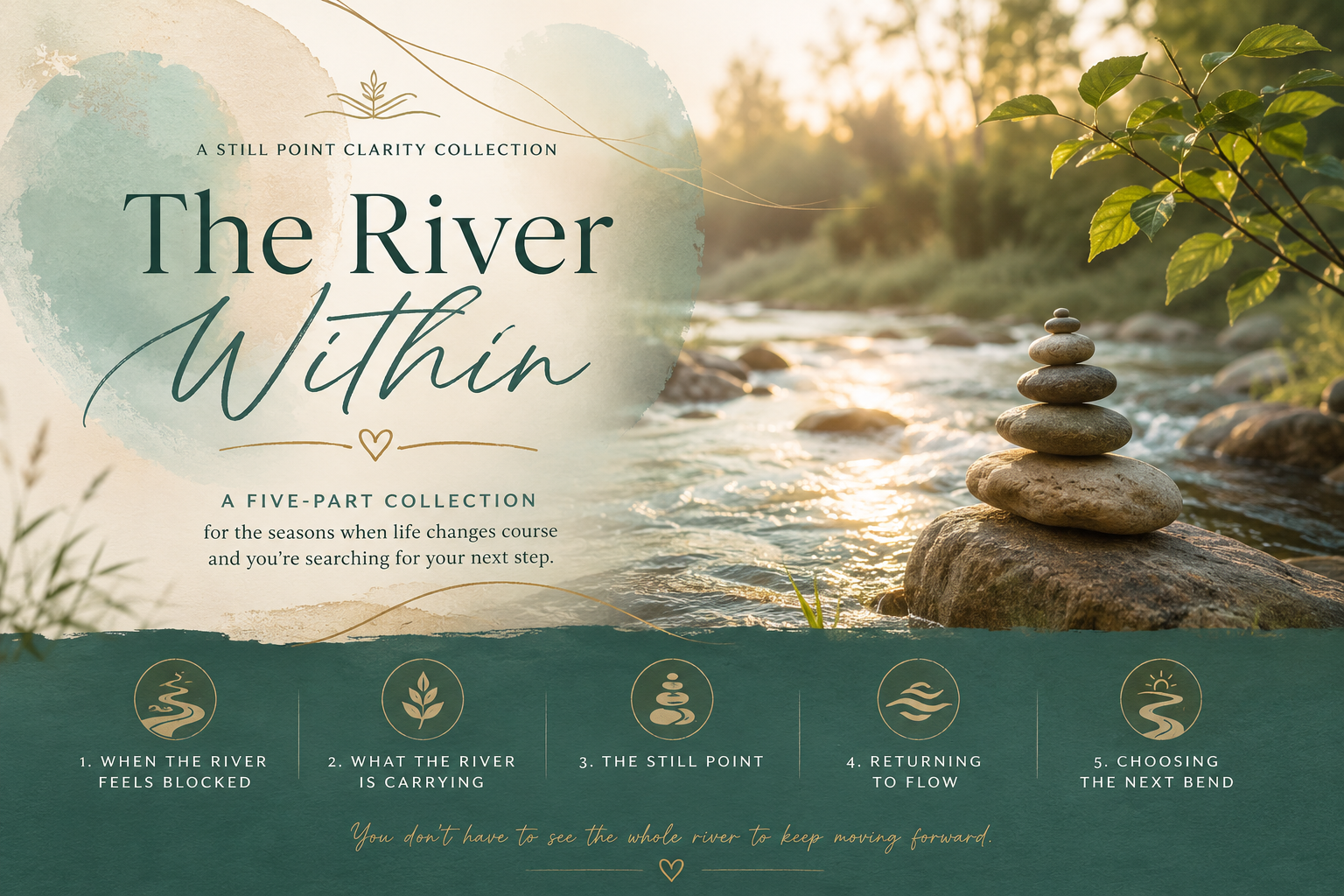
The River Within
A five-part collection for the seasons when life changes course.